
 Donate


Leaders : Nathalie Chaput-Gras, Gaëtane Nocturne, Marie Naigeon
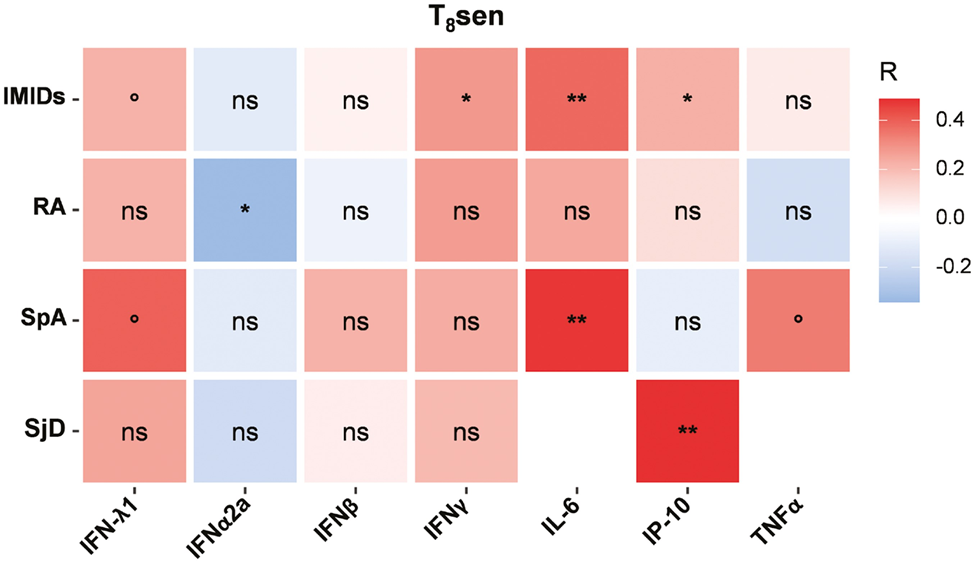
Scientific publication : Expanded senescent CD8 T cells in IMID patients are associated with distinct inflammatory cytokines
Clinical and Experimental Immunology, Volume 219, Issue 1, 2025, uxaf050
Clin Exp Immunol, Volume 219, Issue 1, 2025, uxaf050, https://doi.org/10.1093/cei/uxaf050
Etude des marqueurs de sénescence lymphocytaire sous anti-TNFαRationnel de l’étude : SIP: LT CD8+ CD28- CD57+ KLRG1+SIP and prognosis
Pubmed :
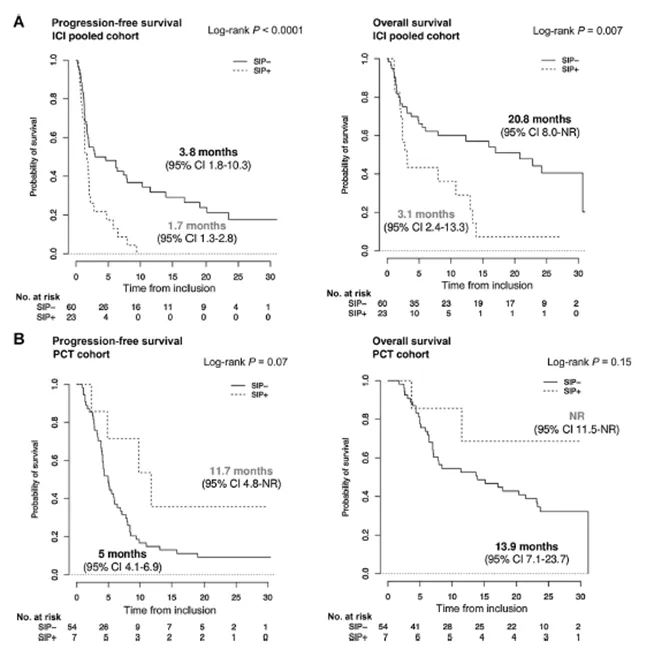
Ferrara R, Naigeon M, Auclin E, Duchemann B, Cassard L, Jouniaux JM, Boselli L, Grivel J, Desnoyer A, Mezquita L, Texier M, Caramella C, Hendriks L, Planchard D, Remon J, Sangaletti S, Proto C, Garassino MC, Soria JC, Marabelle A, Voisin AL, Farhane S, Besse B, Chaput N.
Clin Cancer Res. 2021 Jan 15;27(2):492-503. doi: 10.1158/1078-0432.CCR-20-1420. Epub 2020 Sep 4.
Pr. Chaput and Pr. Nocturne are presenting a collaborative project exploring cell senescence and its implication in autoimmune diseases, cancer and chronic viral infections.
The objective of this project is to understand the potential common and opposing mechanisms leading to T cell senescence and the means to control it in autoimmunity, cancer and chronic viral infections.
In this context, Pr. Carbonnel suggested exploring Crohn’s disease as part of this project.
Pr. Mariette noted that this collaborative work perfectly embodies the spirit of the FHU CARE, which aims to create synergies between teams.
Rationnel de l’étude SIP: LT CD8+ CD28- CD57+ KLRG1+
1
SIP & Cancer
Un phénotype immunitaire sénescent (SIP) est observé chez les patients atteints de CBNPCa et prédit la résistance aux
anti-PD-1/PD-L1
2
SIP & Inflammation
L’inflammation chronique pourrait favoriser les LT sénescents
3
SIP & anti-TNFα
Chez des patients atteints de MAI, les anti-TNF pourraient modifier le SIP et être utile pour améliorer l’efficacité des anti-PD-1 dans le cancer.
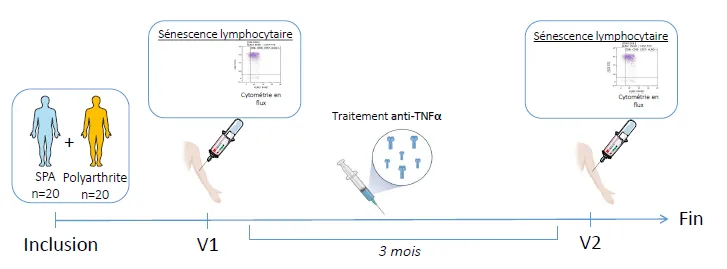
Outline of the clinical trial
Our first results?
Pr. Chaput and Pr. Nocturne present a collaborative project to explore lymphocyte senescence and its implication in autoimmune diseases and cancer.
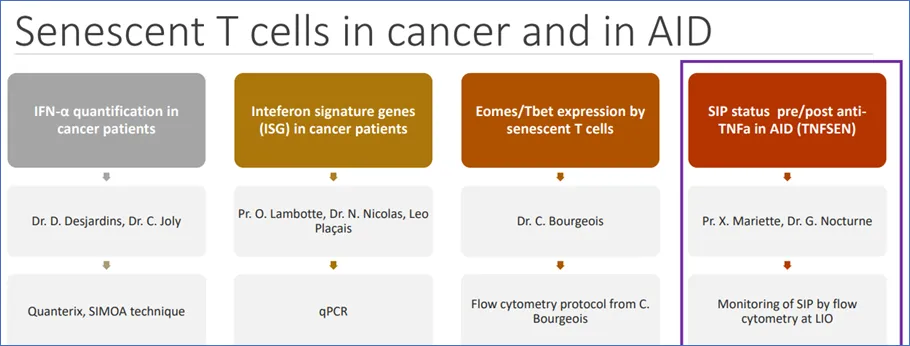
Pr. Chaput’s team has demonstrated the presence of senescent CD8+ T cells in lung cancer patients and high levels of these cells would be associated with resistance to anti-PD-(L)1 antibody. In addition to the physiological immune aging with age, senescent T cells can accumulate following chronic antigenic stimulation (cancer, autoimmune diseases) or in inflammatory diseases such as diabetes.
The objective of TNFSEN is to study T cell senescence in autoimmune diseases (rheumatoid arthritis, ankylosing spondylitis and Sjögren’s syndrome) and its evolution during anti-TNF-α treatment. This study will allow to investigate common or opposite mechanisms leading to senescence, in cancer and autoimmune diseases.
In this context, Pr. Franck Carbonnel suggested exploring Crohn’s disease. This collaborative work perfectly embodies the spirit of the FHU, which aims to create synergies between teams.
Recently, a first analysis on cytometry data and assays of factors associated with inflammation was conducted.
Since 2022, Sjögren’s disease and cytokine measurements have been added. Key results :
- This senescence is mainly driven by IFNs
- No association with disease activity
- Increased SIP in IMIDs (Sjögren, RA, SpA)
These results highlight a strong link between the signature and IFNs. Further studies are planned to explore this pathway and to evaluate new therapeutic strategies capable of reversing senescence.
To summarize TNFSEN :
- SIP in IMIDs
– HV
– Cancer - No association with disease activity
- No modulation under anti-TNF therapy
- Association with IP-10